The Constraint That Helps an Idea Take Its First Shape
A deliberate creative constraint, such as a small format or limited palette, gives an open-ended idea a workable first shape without closing off discovery.
You have a blank sheet of watercolor paper, a pencil, and an idea that keeps changing whenever you try to describe it. A single creative constraint—a small format, perhaps, or a limited palette—can give that idea its first shape without deciding what the finished work must become.
The useful limit is not a punishment or a test of ingenuity. It is a temporary boundary that makes the next choice visible. Instead of choosing everything at once, you choose within a smaller field and see what begins to matter.
What should a creative constraint do?
A good constraint narrows the work without dictating its meaning. “Make a drawing that feels like the quiet after rain” names a direction; “use only graphite” limits the means. The first may remain open, while the second gives your hand a practical starting point.
For an early idea, favor a limit you can change easily. A page size, a short working session, or a small selection of materials can focus attention while leaving room to discover the subject, mood, and arrangement as you work.
- It should be clear. “Use two colors” is easier to act on than “keep it simple.”
- It should be relevant. Choose a limit that makes the idea easier to approach, not one that merely sounds clever.
- It should be reversible. If the work needs more room or a different material, you can revise the boundary.
Think of the constraint as a starting condition, not a verdict on what the work is allowed to be. A first decision can reduce the pressure of an empty page, then give way when the work offers a better direction.
Which limit gives an open idea somewhere to begin?
Pick the kind of decision that currently feels most tangled. If you cannot picture the composition, limit the format. If every color seems possible, choose a palette. If the project feels too large to enter, set a brief session for making one small part.
Does a small format help with a large subject?
It can make a broad idea approachable by asking you to select one image or relationship rather than cover everything. A small sheet or index card may suit a single visual thought, while a longer subject might need a sequence of small panels instead.
Can a limited palette still carry a strong mood?
Yes, because a few colors make their relationships easier to notice. Try choosing colors for their roles—such as a dark, a light, and an accent—rather than expecting a palette to explain the idea on its own.
Should the constraint limit time or materials?
Limit materials when tool choice is delaying a first mark; limit time when you keep expanding the preparation. Keep the boundary modest enough that you can begin without rushing through decisions the idea needs.
How do you choose a limit that serves the idea?
Start with the point of friction. Ask yourself what makes beginning difficult: too many possible subjects, too many tools, uncertainty about scale, or an urge to solve the whole piece before touching the materials. Then choose one limit that addresses that specific obstacle.
A useful constraint often connects to the idea rather than sitting beside it. A project about repetition might use a repeated shape; a study of a dim interior might use a restrained range of values. The connection need not be profound. It only needs to prompt a concrete choice.
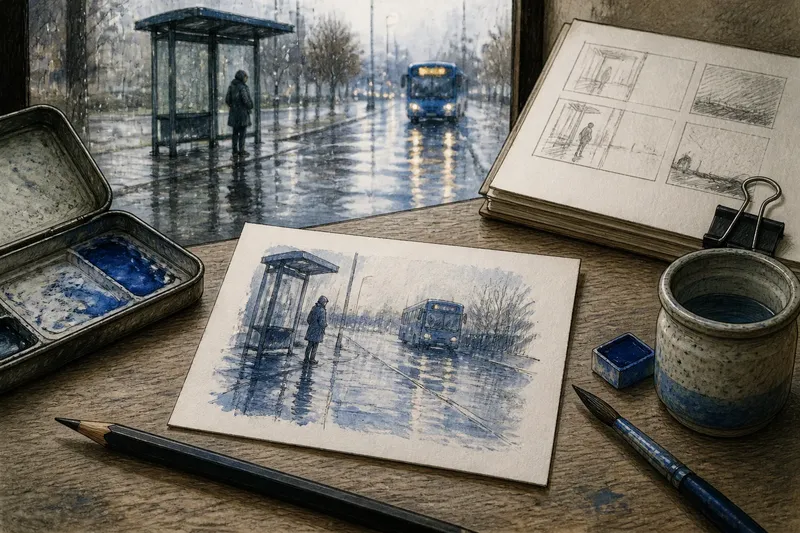
Say you want to draw the feeling of waiting for a bus on a rainy afternoon, but the idea keeps turning into a list of details: people, reflections, signs, and traffic. You decide to work in a narrow rectangle and use only pencil and one blue watercolor. That boundary may lead you to emphasize the long curbside reflections and a single waiting figure; if the image feels cramped, you can widen the format on the next sheet. The point is not to keep every limit. It is to discover what the first one lets you notice.
What happens after the first attempt?
Look at what the constraint made easier to see. Did the small format bring the subject into focus, or did it crowd the relationships you wanted to explore? Did the palette help establish a mood, or did the idea depend on color differences you had left out?
Write down one observation before changing anything. “The empty space feels important” is more useful than “this needs work,” because it gives the next attempt a direction. You might keep the format but add a color, or keep the palette while moving to a larger sheet.
Change one boundary at a time when you want to understand its effect. If you alter the format, palette, and materials together, the result may still teach you something, but it will be harder to tell which change opened the work. This is a practical preference, not a rule: sometimes a fresh start matters more than isolating a single variable.
Can a constraint become too restrictive?
Yes. A limit has stopped helping when you spend more effort obeying it than responding to the idea. You may be forcing an image to fit a format that distorts its central relationship, or keeping a palette that no longer supports the mood you are finding.
When that happens, decide whether to adapt the constraint, set it aside, or carry one useful part into a new attempt. If the page is too small, retain the color choice and enlarge the format. If the material feels wrong, keep the composition and change what you are working with.
There is no need to defend an early boundary simply because you chose it. Its value lies in helping you make contact with the idea. Once it begins to obstruct that contact, changing it is part of the work.
How can a constraint stay a tool rather than a rule?
Give the limit a clear scope: “for this first drawing,” “for this page,” or “until I can see the composition.” A defined scope makes it easier to use the constraint without turning it into a promise about the entire project.
Then leave a small note beside the work naming what you want to carry forward. It might be a shape, a contrast, a color relationship, or a question. That note preserves the discovery even if you discard the format or material that helped reveal it.
A deliberate creative constraint works best when it creates a next move, not a narrow definition of success. Choose one boundary that answers the difficulty in front of you, make a first attempt, and keep whatever the attempt helps you see. The idea can take its first shape there, while still changing as you learn what it wants to become.