Sketchbook or Scrap Paper: Two Places to Catch a Thought
Sketchbook or scrap paper: compare how each captures, sorts, and preserves early ideas so you can choose a place that is easy to use and revisit.
You have a pencil in hand and a thought that may disappear before you reach your desk. The sketchbook is on a shelf; a scrap envelope is beside the kettle. Choosing between a sketchbook or scrap paper is less about which material is better than about what makes a thought easy to catch, sort, and find again.
Is a sketchbook or scrap paper better for catching ideas?
Scrap paper is often easier for a thought that needs capturing immediately; a sketchbook is often easier when you want ideas to stay together. The practical choice is the surface you can reach and use without turning a fleeting notion into a small administrative task.
A loose sheet can be taken from a grocery list, an old printout, or a paper bag. That convenience suits quick diagrams, scraps of dialogue, color notes, and visual arrangements. But loose paper can travel separately from the thought that made it useful.
A sketchbook gives marks a shared home. Opening it takes a little more intention, but the pages provide a continuing record and keep neighboring experiments close. If the book feels too precious to mark, though, its order may come at the cost of spontaneity.
Ask what usually interrupts you. If the idea arrives while you are moving between rooms, keep scrap paper where you tend to pause. If you return to ideas by browsing past pages, keep a sketchbook within reach of the place where you work.
What makes a sketchbook easy or difficult to use?
A sketchbook is useful when its format fits the work and its pages invite unfinished marks. A compact book can slip into a bag; a larger one gives room for broad gestures, pasted fragments, or notes alongside drawings. Paper texture matters, too: a pencil may glide differently on a smooth page than on a toothier one.
Binding affects how the book behaves on a table. A book that opens comfortably can make it easier to draw across a spread; a tightly bound spine may encourage smaller marks near the center. If you use watercolor, marker, or glue, check the paper’s suitability before committing to that medium. Labels and manufacturer instructions are the right guide when material compatibility matters.
The social feeling of a book can matter as much as its paper. Some people hesitate to put an awkward phrase or clumsy thumbnail beside a finished-looking page. You can loosen that pressure by treating the book as a working surface, not a display object, or by choosing a plain, inexpensive notebook for raw ideas.
There is also a useful distinction between keeping a book and keeping every thought in it. Pages can contain abandoned directions without requiring you to develop them. A sketchbook records what crossed your mind; it need not serve as a promise to finish each mark.
When does loose scrap paper make more sense?
Loose scrap paper makes sense when you want freedom to move, compare, or discard pieces. You can spread several sheets across a table, rotate them, put them beside a reference image, or pass one to a collaborator. That physical flexibility is valuable when an idea is still changing shape.
The paper itself can influence what feels possible. The back of a draft printout invites a quick note; a torn piece of cardboard may suit a rough composition; a sticky note can mark a place without becoming a permanent page. Reusing clean, readable paper also makes the surface available without waiting for a new notebook.
Loose sheets become difficult when there is no obvious place for them afterward. A note may be legible but detached from its context: Was that sketch for a poster, a room layout, or a character? A small mark at the top—such as a project name or a few words about the moment—can make later sorting less dependent on memory.
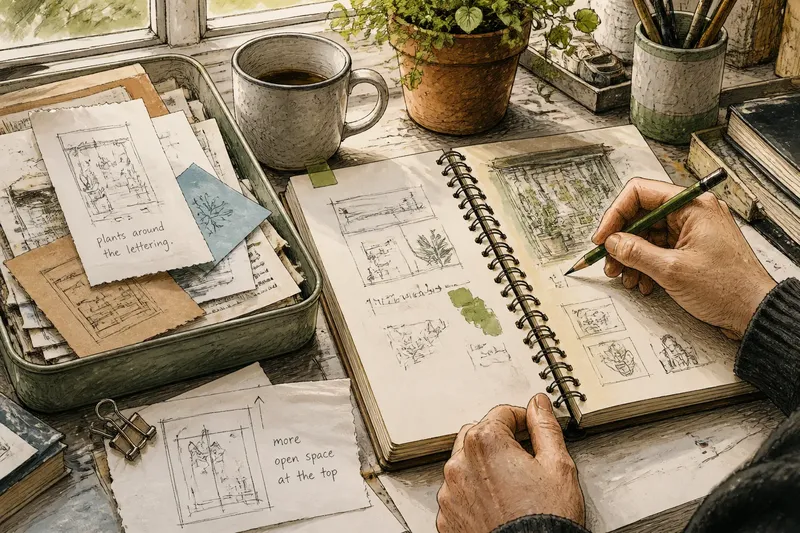
Imagine you are sketching a possible window display while waiting for a friend. You draw the arrangement on the blank back of a receipt, then add a short note, “plants around the lettering.” When you get home, placing that receipt in a folder marked for the shop gives the idea a route back to you without requiring the sketch to become a page in a book.
How can you sort and revisit early ideas?
Use a sorting method that preserves enough context to recognize an idea later. A sketchbook already gives you sequence: pages before and after a mark can hint at what you were exploring. Loose paper needs a little more help, such as a folder, envelope, clip, or shallow tray assigned to one project or kind of work.
Try not to sort by judging every idea as promising or useless. Early marks can be valuable because they show a direction, a question, or a visual relationship, even if you never use the exact drawing. Sorting by project, medium, or date can leave room for an idea to become useful in an unexpected way.
When revisiting, look for the prompt or decision attached to the mark. A page with a rough shape and a note like “more open space at the top” tells you what you were considering. A detached shape without context may still be intriguing, but it asks you to reconstruct the moment from scratch.
- For a sketchbook, add a brief title or date when a page begins a distinct line of thought.
- For loose sheets, keep a named folder or envelope close to the place where you make them.
- Attach small pieces to a larger sheet if they belong together, leaving room for a note about their relationship.
- Set aside a place for ideas that are active now, separate from material you are simply keeping.
- When a fragment moves into a larger work, preserve the original if its roughness or surrounding marks still explain the idea.
These are options, not a filing system to maintain for its own sake. If sorting takes longer than the act of capturing, simplify the categories or leave the paper in one visible holding place until you have a reason to retrieve it.
Can you combine a sketchbook with scrap paper?
Yes. A hybrid approach lets each surface do the job it handles comfortably: loose paper catches marks quickly, while a sketchbook gathers the ideas you want to develop or revisit. There is no need to transfer every scrap into a permanent record.
You might tape a selected sheet into a book, tuck it into a pocket, or redraw its useful part on a page with a note about what changed. Choose based on what you need to remember. If the sheet’s placement, scale, or messy surroundings matter, keep the original; if only one shape matters, a brief redraw may be enough.
For work that involves other people, the distinction can help keep private exploration separate from material you intend to share. A book or loose sheet can hold tentative fragments without being treated as presentation-ready. If you later show the idea, you can choose a clear version that communicates it without exposing unrelated notes.
Which surface suits different creative habits?
A sketchbook may suit you if you often build on yesterday’s marks, enjoy seeing a sequence, or want a portable record of visual thinking. It can also help when you use recurring tools, such as graphite, colored pencil, or a fine-line pen, and prefer to keep them with one familiar surface.
Scrap paper may suit you if thoughts arrive in brief bursts, if you like rearranging pieces, or if a blank new page feels too formal. It can be especially convenient for notes made around the house or studio, where the nearest usable surface may be more important than consistent paper.
Neither preference has to become a rule. A person who mostly works in a sketchbook may still keep index cards for compositions that need rearranging. Someone who collects loose sheets may reserve a notebook for a continuing visual journal. The choice can follow the task rather than define a creative identity.
What should you ask before choosing a place for an idea?
Do ideas need to stay in sequence?
If the order in which ideas appear helps you understand them, a sketchbook offers that sequence naturally. If order is incidental, loose sheets may be easier to move and group.
Will the idea need to move between places?
A sheet can be carried, placed beside references, or handed to someone without moving the rest of your notes. A sketchbook keeps the work together but may be less convenient when you need only one fragment.
What tools and materials will you use?
For quick pencil notes, nearly any clean surface may do. For wet media, heavy glue, or marks that might bleed, choose a surface intended for that use and follow the material’s directions.
Will you want to find this thought later?
If so, give it context as you capture it: a project name, a short prompt, or a nearby reference. A well-labeled scrap can be easier to retrieve than an unlabeled sketchbook page buried among unrelated work.
How do you choose without making capture feel formal?
Start with the surface that removes the most friction in your actual setting. Put a notebook by the drawing tools if you naturally sit down to think, or keep a small stack of reusable paper near the place where ideas tend to appear. Notice which surface you reach for without deliberating, then make it easier to find there.
It can help to define a modest role for each. For instance, use scrap paper for fragments that need to be moved around, and a sketchbook for thoughts you want to keep in sequence. This is not a rule for what counts as serious work; it is a way to reduce the pause between having an idea and making a mark.
Choosing between a sketchbook or scrap paper is ultimately a choice about how much continuity a thought needs. A loose page can preserve its freedom; a bound page can preserve its neighbors. Keep the arrangement that makes returning to an idea feel possible, and let the surface remain ordinary enough that you are willing to use it.
One small adjustment can tell you whether your arrangement is working: leave the chosen surface with a pencil or pen close by, and keep the place for saved fragments visible. When the next thought arrives, the useful question is not whether it deserves a perfect page, but where it can land before it slips away.