A Small Work-in-Progress Share, Planned with Care
A work-in-progress share can invite useful feedback without turning a draft into a group project, leaving you clearer about what to keep, change, or set aside.
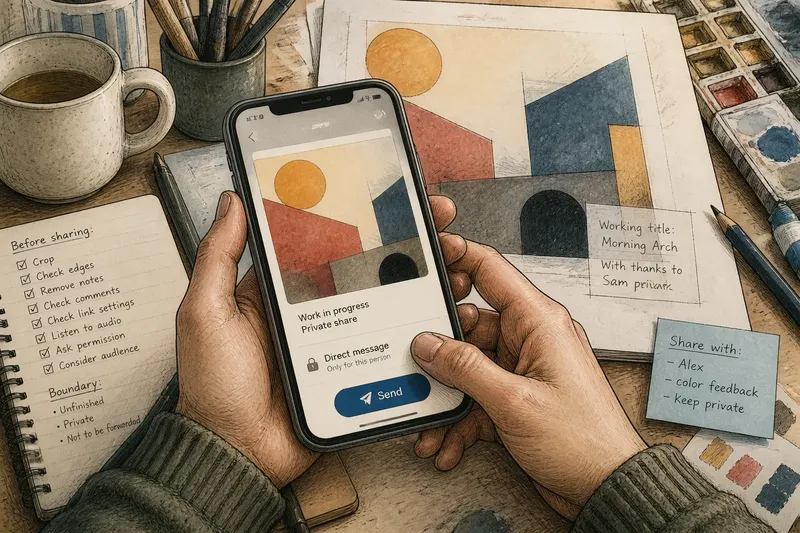
You pause over a photo of the drawing on your kitchen table, thumb hovering above the send button. A small work-in-progress share can be less exposing when you decide what the image is for before you send it—and what parts of the process you want to keep private.
Sharing unfinished work does not make the audience a co-author. It gives someone a view of a particular moment in your process; you still decide what the work becomes. The most useful preparation is not a narrow critique question, but a clear boundary around access: what you are comfortable showing, who may see it, and whether it can be passed along.
What should a work-in-progress share make clear?
A work-in-progress share should make its status and boundaries easy to understand. A sketch, a page from a draft, an audio excerpt, or a prototype can be shared without presenting it as a finished piece. Say plainly that it is unfinished, and be specific about what you are permitting: a private conversation, comments in a shared document, or viewing in a workshop.
Privacy is not only about sensitive subject matter. A file may contain names in its comments, a photograph may show other work on your desk, and a shared link may allow viewers to forward it. Before sending, inspect the actual image or file, remove details you do not want included, and choose access settings that fit the audience. If you are unsure whether a platform’s settings prevent copying or forwarding, assume they may not.
Who should see unfinished work?
Choose people with care, not just people who are available. A trusted friend may be kind but unfamiliar with the craft; a workshop peer may understand the medium but not know how private you want the material kept. Consider both their ability to respect your boundaries and the consequences if the work travels beyond them.
You can share with one person, a closed group, or a public community, but those choices carry different levels of control. A direct message is still a digital copy. A closed workshop may have shared expectations, but it cannot remove every participant’s ability to save or repeat what they saw. Public posting offers the least control over where an image or excerpt appears later.
If a piece includes another person’s words, image, or private story, consider their permission and the context before sharing it. For legal questions about rights or consent, ask a qualified professional; general courtesy cannot settle every situation.
How can you prepare the file without exposing more?
Make a deliberate pass through the material before sending it. Crop a drawing to the area you mean to show, check a document for private comments, and listen to an audio clip from beginning to end for background conversation. Use a plain filename rather than one that reveals personal details, and check who can open the link.
- Check the image edges for addresses, faces, or unrelated work; if they appear, crop or retake the image, then review it again before sending.
- Check the document’s comments and revision history; if they contain private notes, remove them or make a clean copy, then verify the shared version.
- Check the link settings; if anyone with the link can view or edit and that is broader than intended, restrict access or choose a different sharing method.
- Check the audio for names or background speech; if private details are audible, trim the clip or select another excerpt, then listen to the revised file.
- Check whether the audience may save or forward the material; if that possibility makes you uncomfortable, share less, show it in person, or wait.
- Check whether everyone pictured or quoted has agreed to this audience; if not, remove identifying material, seek permission, or keep the work private.
These checks do not make a share risk-free. They help you notice what is included and choose an audience and format that match your comfort.
What questions do creators ask before sharing?
Can I share work that is still rough?
Yes, if you are comfortable with the people who will see it and the material is ready for the kind of response you want. You can also share a detail or excerpt rather than the whole piece.
How do I ask people not to forward it?
Say directly that the work is private and ask them not to copy, post, or pass it along. Treat that request as a boundary to communicate, not a technical barrier that can prevent every copy.
Should I use a public post or a private message?
A private message limits the intended audience more clearly, though recipients can still save or share it. A public post is easier to discover and pass along, so share only material you can accept being seen outside its original context.
What if I change my mind after sending?
You can ask recipients to delete their copies and remove a post or shared link where you control it. You may not be able to retrieve every copy, so pause before sending if the possibility of wider circulation would trouble you.
How do you make a sharing decision in practice?
Imagine you have a rough poster saved as a JPEG, with a working title and a collaborator’s name in a corner note. You want a friend to see the color arrangement, but you do not want the design posted elsewhere. First, you crop the image to remove the note and inspect the edges for other identifying details. Next, you send the clean file directly rather than posting it in a public group, and you write that it is an unfinished private share that should not be forwarded. The friend replies that the colors are easy to distinguish. The result is a response to the part you chose to show, while the remaining tradeoff is clear: a direct message narrows the audience but cannot stop the recipient from saving the image.
That kind of decision does not require elaborate rules. It asks you to notice what is in the file, how far it may travel, and whether you are willing to accept that reach. A small work-in-progress share can preserve your control over the work’s next direction while still letting someone witness its progress. Before the next share, check the audience again; a new file or platform can bring new privacy details with it.